

Court Fence Wind Load in Florida: What the Building Code Expects

Mor-Sports Group • November 11, 2026

Share this article

A bare chain link court fence lets most wind pass through, but once you hang windscreens on it, the fence starts acting like a solid wall and the load on every post climbs. In Florida, that fence is designed to the wind speeds in the Florida Building Code, which are highest in the High Velocity Hurricane Zone of Miami-Dade and Broward counties. Getting post size, post spacing, footings and windscreen choice right at the start is what keeps a court fence standing after a storm.

Why Windscreens Turn a Fence Into a Sail

Open chain link fabric has a lot of free area, so wind slips through it. Windscreen closes that free area. The Chain Link Fence Wind Load Guide (WLG 2445) from the Chain Link Fence Manufacturers Institute shows why this matters. Its post spacing tables start by assuming a fully solid fence panel, then apply a fabric coefficient that lets you space posts farther apart only because open mesh lets wind through. Cover that mesh with screen and you lose much of that allowance.

ASTM's tennis fence standard says the same thing in plain terms. ASTM F969, Standard Practice for Construction of Chain-Link Tennis Court Fence, covers 10 and 12 foot court fences and cautions that if windscreens will be added, now or later, the fence should get stronger framework, closer post spacing or back bracing. It points designers to the CLFMI guide to pick post size and spacing.

So tell your builder up front if you ever plan to hang windscreens. A fence built for open fabric and screened later is the classic storm failure. If you're planning tennis court construction, put the windscreen plan in the fence design from day one.

Which Florida Building Code Applies Right Now

As of October 2026, Florida enforces the8th Edition (2023) Florida Building Code, which took effect December 31, 2023. The Florida Building Commission's ASCE 7-22 fact sheet confirms that the 8th Edition references ASCE 7-22 for wind loads.

A change is close. The Commission's 9th Edition workplan sets December 31, 2026 as the 9th Edition (2026) effective date, and Miami-Dade's permitting notice says applications filed on or after that date must meet it. Filing near year end? Ask which edition the plans follow.

How wind speed is set

Under FBC Building Chapter 16, Section 1609.1.1 says wind loads on every building or structure come from Chapters 26 to 30 of ASCE 7. Section 1609.3 sets the ultimate design wind speed from four maps, Figures 1609.3(1) through 1609.3(4), one for each risk category. Each structure gets a risk category under Table 1604.5, and the engineer or designer picks the matching map.

Wind speeds vary a lot across the state, so use the address, not a guess. The Commission's fact sheet notes that site specific speeds can be taken from the ASCE 7 Hazard Tool, and that local jurisdictions often adjust the maps, so check with the building department for your site.

The High Velocity Hurricane Zone

The FBC Chapter 2 definitions state that the High Velocity Hurricane Zone (HVHZ) consists of Broward and Miami-Dade counties. Inside the HVHZ, Section 1601.1 sends designers to Sections 1616 through 1626 (plus 1605, 1607, 1611 and, in flood areas, 1612) instead of the standard provisions.

Section 1620.2 sets HVHZ wind speeds by county and risk category:

  • Miami-Dade: 165 mph (Risk Category I), 175 mph (II), 186 mph (III), 195 mph (IV)
  • Broward: 156 mph (I), 170 mph (II), 180 mph (III), 185 mph (IV)

Section 1620.3 also treats all HVHZ structures as Exposure Category C unless Exposure D applies.

There's one fence rule worth knowing. Section 1616.2.1 lets fences that are 6 feet or less in height be designed for a 115 mph 3-second gust. A court fence is usually 10 or 12 feet tall, so that shortcut doesn't fit most courts. Expect full wind design for court fencing in the HVHZ.

Permits and Engineering for Court Fences

Permit rules are set locally, so they change by county and city. Two examples show how different they can be:

  • Miami-Dade County: the county's Fences and Gates page says chain link fences on commercial properties need a building permit (Building Permit Application, category 18), while residential chain link that isn't a pool barrier goes through a Zoning Improvement Permit.
  • Lee County: the county's Residential Fence or Wall permitting guide requires a permit to install or replace a fence, and asks for plans signed and sealed by a Florida registered architect or engineer when a fence or wall is over 6 feet. That sealed plan rule excludes chain link fences.

HOA, club and backyard courts can land in different permit categories in the same county, so your contractor should confirm the category and any sealed drawing requirement with the building department before ordering posts.

Post Spacing and Footing Basics

The CLFMI guide covers wind speeds from 105 to 210 mph and is based on ASCE 7-22. Its tables are written for Exposure B, with conversion factors for Exposures C and D, and they're adjusted for fabric gauge, mesh size and icing. In the guide's own worked example (150 mph, Exposure C, open fabric, a trial 3.5 inch line post), the math lands at about 8 feet between posts. Your numbers will differ, which is exactly why the guide carries a disclaimer telling owners to have a qualified professional engineer assess each site.

What a board or owner should ask for in a bid:

  1. The design wind speed, risk category and exposure used for the fence.
  2. Whether the fence is designed with windscreens on, and on which sides.
  3. Line post size, terminal post size and maximum post spacing.
  4. Footing depth and diameter, and the soil assumption behind them.
  5. Whether sealed engineering is included or required by the permit office.

Footings are where Florida soil matters. CLFMI's example assumes silty sand and says real soil properties should come from a geotechnical engineer, so ask how footing size was chosen.

Choosing Windscreens That Fail Safely

Windscreen choice and attachment both affect fence load.

  • Open weave or vented screen. Mesh screens pass more air than solid vinyl. Some manufacturers sell vented designs aimed at lowering wind load, such as Ball Fabrics' ExtremeScreen 80 , which won ASBA's 2024 Game Changer Award. Ask the supplier for the screen's rated open area and have the fence designer use it.
  • Breakaway ties. Windscreen supplier 10-S Tennis Supply recommends 50 lb breaking strength ties, which are meant to snap in high wind and release the screen before the fence takes damage. It advises against rope as the only fastener because a roped screen can act as a sail and pull the fence down.
  • Avoid permanent hardware. The USTA and U.S. Tennis Court and Track Builders Association manual, Tennis Courts: A Construction and Maintenance Manual (1998 edition), notes that S hooks and hog rings are hard to remove before storms and that lacing cord generally won't break, so a laced fence may bend under heavy wind.

Take Screens Down Before Storms

10-S recommends removing windscreens when you have advance notice of gusts above 40 mph. For context, the National Weather Service defines tropical storm conditions as sustained winds of 39 to 73 mph, and a Tropical Storm Watch means those conditions are possible within 48 hours. In practice, a watch for your area is your cue to start pulling screens.

If you can't remove screens in time, Ball Fabrics' hurricane prep guide describes fold down and roll up methods as last resorts and says full removal is the safest option. Label each panel so it goes back in the right spot.

After a storm, check for bent rails, leaning posts and cracked footings before rehanging anything. New cracks or ponding are a good reason to talk about tennis court resurfacing.

Frequently Asked Questions

Is Miami-Dade the only HVHZ county in Florida?

No. The Florida Building Code defines the High Velocity Hurricane Zone as Broward and Miami-Dade counties. Both use the HVHZ sections of Chapter 16.

Does adding windscreens to an existing court fence require a new design?

ASTM F969 advises stronger framework, closer post spacing or bracing when screens are added, so have the fence checked before you hang them. Whether a permit is needed depends on your local building department.

What edition of the Florida Building Code applies to my project?

The 8th Edition (2023) is in force today. The 9th Edition (2026) takes effect December 31, 2026, and permit applications filed on or after that date must meet it.

Planning a new court or replacing a tired fence? Mor-Sports Group has built courts across Florida and Southern Alabama since 1986, and our crews self-perform the work. Request a free estimate and we'll help you plan a fence and windscreen setup that fits your site's wind exposure. For permit or code questions on a specific property, confirm with your local permitting office.

Recent Posts

Tennis court surface and drainage slope
By Mor-Sports Group • November 16, 2026
Florida ERP thresholds, water management district permits and ASBA slopes for new courts, from a court builder working since 1986. Get a free estimate.
Tennis court ready for resurfacing
By Mor-Sports Group • November 13, 2026
How Florida HOAs should budget tennis and pickleball court resurfacing in a reserve study. From court builders since 1986. Get a free estimate.
Tennis court acrylic resurfacing in progress
By Mor-Sports Group • November 9, 2026
When to resurface a Florida tennis or pickleball court around rainy season, cure times and club calendars. Court builders since 1986. Free estimate.
Public park tennis courts in Florida
By Mor-Sports Group • November 6, 2026
How Florida parks and school districts bid court projects: ITB vs RFP, bonds, licensing and specs. From a court builder since 1986. Get a free estimate.
Pickleball court in a residential community
By Mor-Sports Group • November 4, 2026
Pickleball noise mitigation for HOAs, from acoustic studies: distance, walls, quiet paddles, hours. By the 2016 US Open court builder. Get an estimate.
Tennis court base construction
By Mor-Sports Group • November 2, 2026
Post-tension concrete vs asphalt tennis courts on Florida's sandy, wet, karst soils: cracking, lifespan, cost drivers. ASBA award winner. Free estimate.
Backyard tennis court
By Mor-Sports Group • October 30, 2026
How to get HOA architectural approval for a backyard tennis or pickleball court in Florida. Court builder since 1986. Get a free estimate.
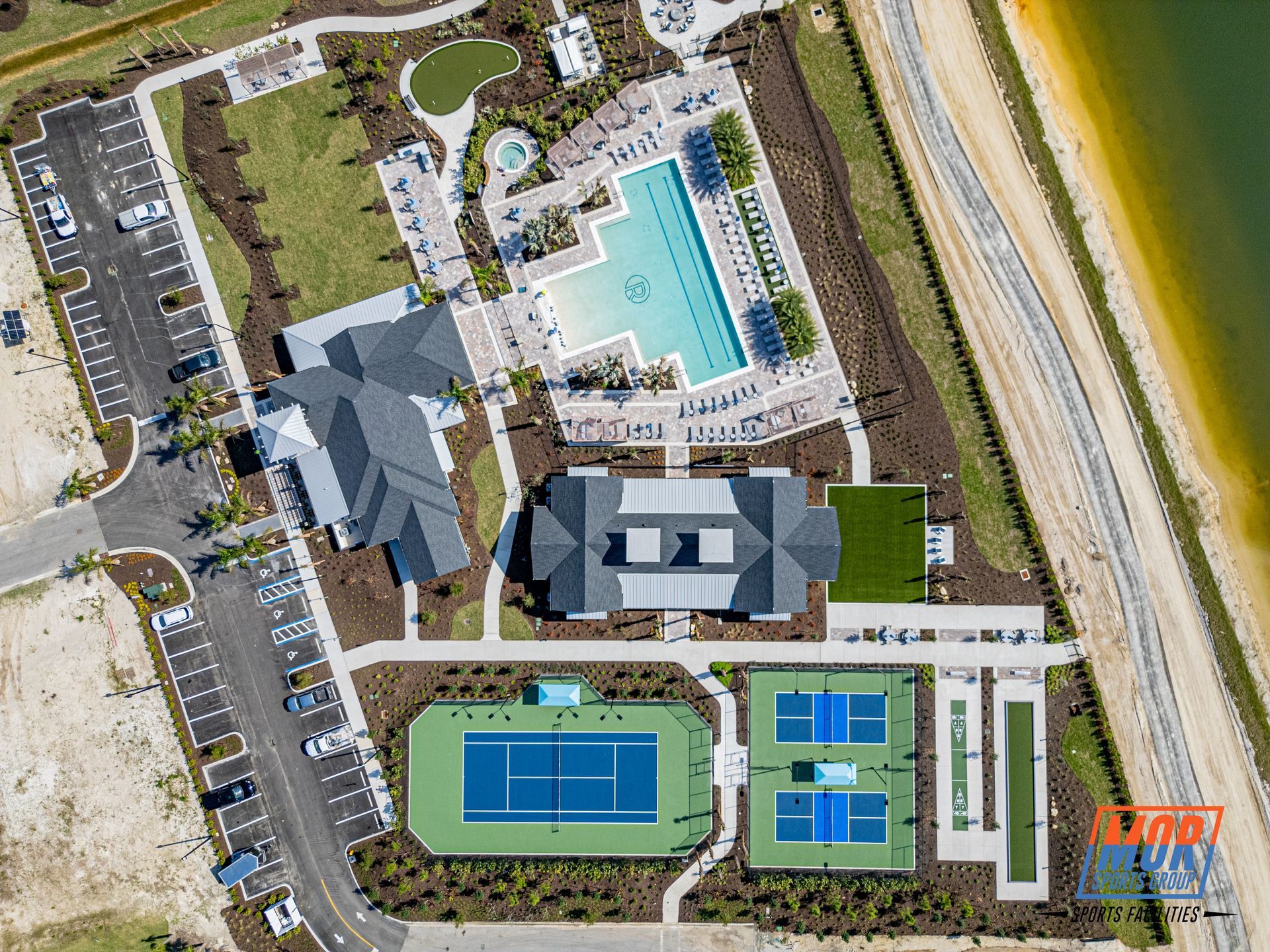
Pickleball courts at Regency at Babcock Ranch
By Mor-Sports Group • October 28, 2026
Plan pickleball courts for a Florida 55+ community: court count, shade, cushion, lighting, ADA access. From an ASBA award-winning builder. Free estimate.
Completed pickleball courts built by Mor-Sports Group
By Mor-Sports Group • October 26, 2026
How Florida HOAs convert tennis courts to pickleball: blended lines, 4-court layouts, board votes, noise. Court builder since 1986. Free estimate.

Court project plans on a table
By Mor-Sports Group • October 23, 2026
Which Florida county office issues tennis and pickleball court permits, and what each one checks. From a court builder since 1986. Get a free estimate.
Show More