


How to Convert a Tennis Court to Pickleball in an HOA

Mor-Sports Group • October 26, 2026

Share this article

An HOA can convert a tennis court to pickleball in three main ways: add pickleball lines over the tennis lines (blended lines), turn one tennis court into up to four dedicated pickleball courts, or rebuild the space as a purpose-built pickleball facility. The right choice depends on how many members still play tennis, how close the courts sit to homes, and what your governing documents require before the board changes a shared amenity. In a Florida condominium, a permanent conversion can count as a material alteration that needs a member vote.

The Numbers: Will Pickleball Fit on Your Tennis Court?

A doubles tennis court is 78 feet long and 36 feet wide under the ITF rules published by the USTA. A pickleball court is 20 feet wide by 44 feet long under the USA Pickleball Official Rulebook, with a minimum playing surface of 30 by 60 feet. For new construction, the rulebook recommends 34 by 64 feet. The net is 36 inches at the sidelines and 34 inches at center.

That math drives every layout. USA Pickleball's guidance on repurposing tennis courts says two pickleball courts fit on one tennis court without greatly interfering with the tennis lines. It's possible to fit as many as four, but the space will be packed with little room between courts. On a pair of tennis courts, USA Pickleball notes that eight pickleball courts can be lined, but six is more comfortable and leaves room for a shaded rest area.

The ASBA and USA Pickleball publish Pickleball Courts: A Construction and Maintenance Manual with conversion drawings. According to ASBA's summary of the 2023 edition changes, the recommended layout for converting a 120 by 120 foot pavement (a typical pair of tennis courts) was revised to allow 6 feet between sidelines and fences. Your builder should work from the current manual, not an old diagram.

Option 1: Blended Lines (Keep Tennis, Add Pickleball)

This is the lightest touch. You keep the tennis court as is and paint pickleball lines on top in a color that's easy for pickleball players to see but easy for tennis players to ignore. Players use portable pickleball nets, or lower the tennis net for a single center court.

Line color matters more than people expect. The ITF guidance printed in the USTA's Friend at Court says blended lines should be in the same color family as the court, lighter than the court, slightly narrower than standard lines, and should stop short of where they'd cross the white tennis lines. That guidance was written for tennis lines like 60-foot youth courts, but the same idea keeps pickleball lines from confusing tennis players. The same document notes that for lines from other sports such as pickleball, a tournament referee decides whether sanctioned matches can be played on the court, unless the sanctioning body says otherwise.

If you're a club that hosts USTA league or tournament play, ask your local league coordinator before you paint. Standard pickleball lines are 2 inches wide per USA Pickleball.

Best for: communities with steady tennis play and growing pickleball interest, or boards that want to test demand before a bigger commitment.

Option 2: Four Pickleball Courts on One Tennis Court

Here the tennis court comes out of service and the slab is lined for up to four dedicated pickleball courts. Permanent net posts go in, the tennis net posts and footings are removed or capped, and the surface is recoated in pickleball colors. Divider fencing between courts keeps stray balls out of the next game.

Four courts on one tennis footprint is tight. Runout behind the baselines and between courts is short. Ask your builder to show you the actual clearances on a drawing, measured to the fence posts, before the board votes.

Best for: communities where tennis use has dropped and pickleball players are waiting for courts.

Option 3: A Dedicated Pickleball Rebuild

When the existing court has drainage problems, structural cracks or a failing base, it often makes sense to rebuild rather than restripe. A full build gives you the space to size each court closer to the 34 by 64 foot new construction recommendation, add proper fencing and shade, and plan lighting from scratch. Our pickleball court construction follows the same published steps as our tennis work: survey and land clearing, laser-graded lime rock sub base to ASBA grades and slopes, laser-paved hot asphalt base, cushion system, then the acrylic color system and lines.

Board Approval, Member Votes and Surveys

Condominiums (Chapter 718).Under section 718.113(2)(a), Florida Statutes, a condominium can't make a material alteration or substantial addition to the common elements or association real property except as the declaration provides. If the declaration is silent on how to approve one, 75 percent of the total voting interests must approve before the work starts. Restriping a court is likely maintenance. Removing tennis and installing permanent pickleball posts and fencing may be a material alteration. That line is a legal call, so have the association's attorney review the scope before you sign a contract.

Homeowners' associations (Chapter 720).Chapter 720 doesn't contain a material alteration section like 718.113, so the declaration and bylaws control who approves changes to common areas. Read them for any member vote requirement on removing or changing amenities. Section 720.304(1) says common areas and recreational facilities must be available to owners for their intended use, and lets the operating entity adopt reasonable rules for that use. That's the basis for court schedules, play hours and tennis time blocks after a conversion.

Member surveys. Even when a vote isn't required, survey members first. Ask how often they play each sport, at what times, and whether they'd accept shared courts. It also gives the board a record of why it chose an option.

Plan for Noise Before You Paint

Pickleball's hard paddle and plastic ball make a sharper sound than tennis, and four courts on one slab means four times the games. Look at the distance from the courts to the nearest homes, which way the courts face, and what landscaping or fencing sits in between. Options include acoustic fence panels, landscape buffers and posted play hours. Our guide to Florida HOA pickleball court noise ordinances covers how local rules apply, and our pickleball setbacks and condo rules guide covers placement.

What Drives the Cost of a Conversion

We don't publish prices because every court is different, but these are the factors that move the number:

  • Surface condition. Cracks, low spots and worn color coats need repair before new lines go down.
  • Number of courts and layout. Blended lines on one court is a small job. Four dedicated courts with new posts is a bigger one.
  • Net posts and footings. Permanent posts need new footings, and old tennis post sleeves need to be dealt with.
  • Fencing and dividers. Divider fences, gates and windscreens add up.
  • Cushion system. A cushioned surface is easier on joints but adds layers.
  • Lighting. Re-aiming or adding fixtures for new court positions.
  • Noise mitigation. Acoustic panels or barriers.

Why Resurface at the Same Time

If your tennis court is due for a recoat, convert during the tennis court resurfacing. You repair cracks once, lay new color once, and stripe the new lines on a fresh surface instead of painting over worn color that will need redoing in a few years. It also lets you pick court colors that contrast with the ball. USA Pickleball advises choosing a surface color opposite the ball color on the color wheel for the best visibility.

Frequently Asked Questions

How many pickleball courts fit on one tennis court?

USA Pickleball says two fit easily without much interference with tennis lines, and up to four can fit with very little space between them. On two adjacent tennis courts, six is the more comfortable layout.

Can we keep playing tennis after adding pickleball lines?

Yes, with blended lines. Paint the pickleball lines in a color close to the court surface so tennis players can ignore them, and use portable pickleball nets.

Does a Florida condo need a member vote to convert a tennis court?

If the conversion is a material alteration to the common elements, section 718.113(2)(a) requires approval as the declaration provides, or 75 percent of the total voting interests if the declaration is silent. Whether your scope counts is a question for your association attorney.

What size is a pickleball court?

The court is 20 feet by 44 feet for singles and doubles. USA Pickleball sets a 30 by 60 foot minimum playing surface and recommends 34 by 64 feet for new construction.

Mor-Sports Group was the Official Court Builder of the 2016 US Open Pickleball Championship and has built courts across Florida and Southern Alabama since 1986 with our own crews. If your board is weighing a conversion, we'll walk the courts and lay out the options. Request a free estimate.

Recent Posts

Court project plans on a table
By Mor-Sports Group • October 23, 2026
Which Florida county office issues tennis and pickleball court permits, and what each one checks. From a court builder since 1986. Get a free estimate.
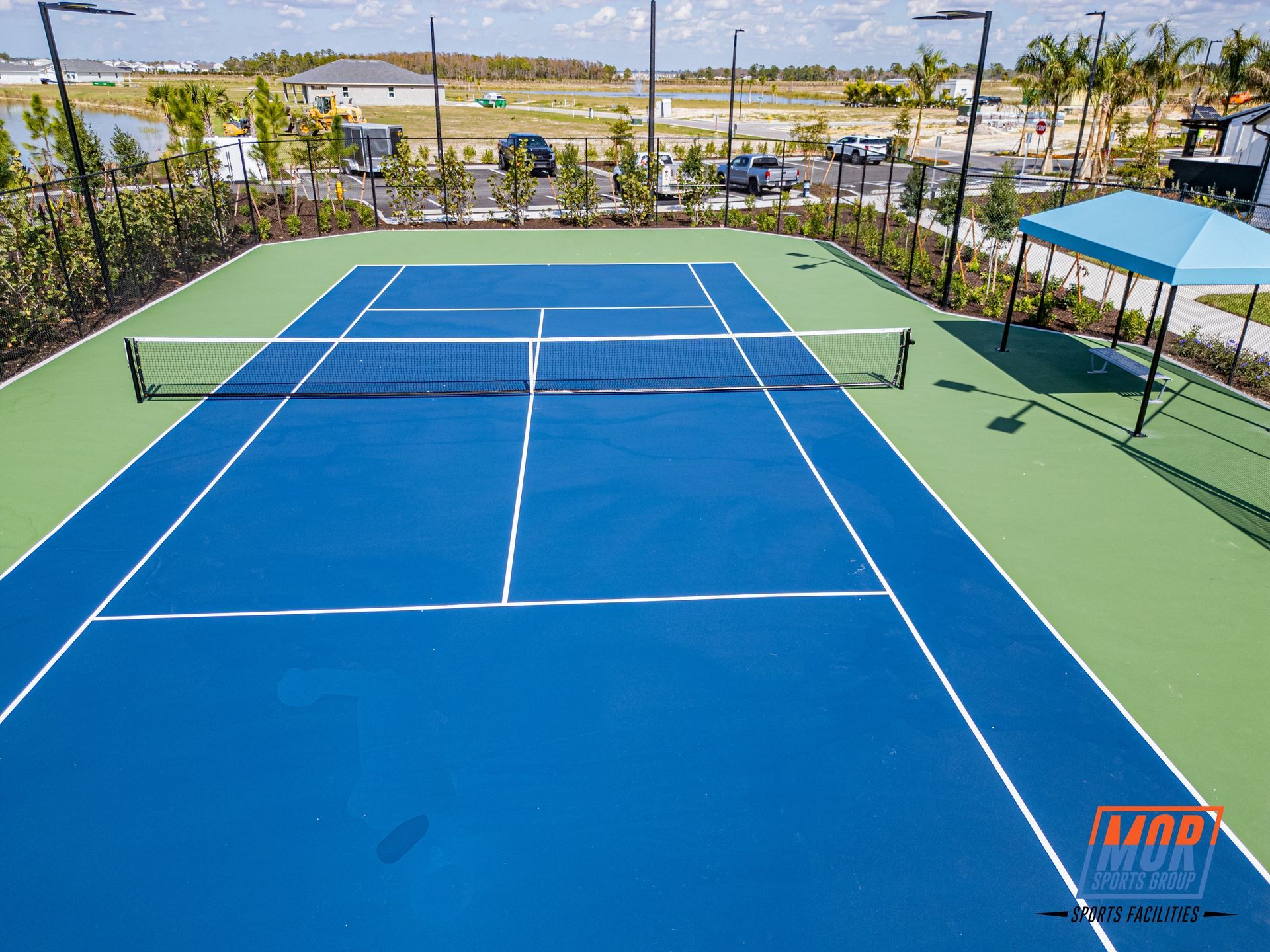
Empty blue tennis court with green sidelines, net, and a beachside resort in the background
By Mor-Sports Group • September 3, 2026
Mor-Sports Group won a 2026 ASBA Facility Award in the Tennis and Pickleball Facility category for the courts we built at Regency at Babcock Ranch in Punta Gorda, Florida. Here is how the project was built.

Podcast interview graphic with two speakers and bold text: “The Standard for Sports Construction”
By Mor-Sports Group • September 2, 2026
Nick Blackwood and Leslie LoGelfo joined the Move Swiftly podcast to talk self-performed court construction, the rise of padel, cushion surfaces and what communities should ask before they build.
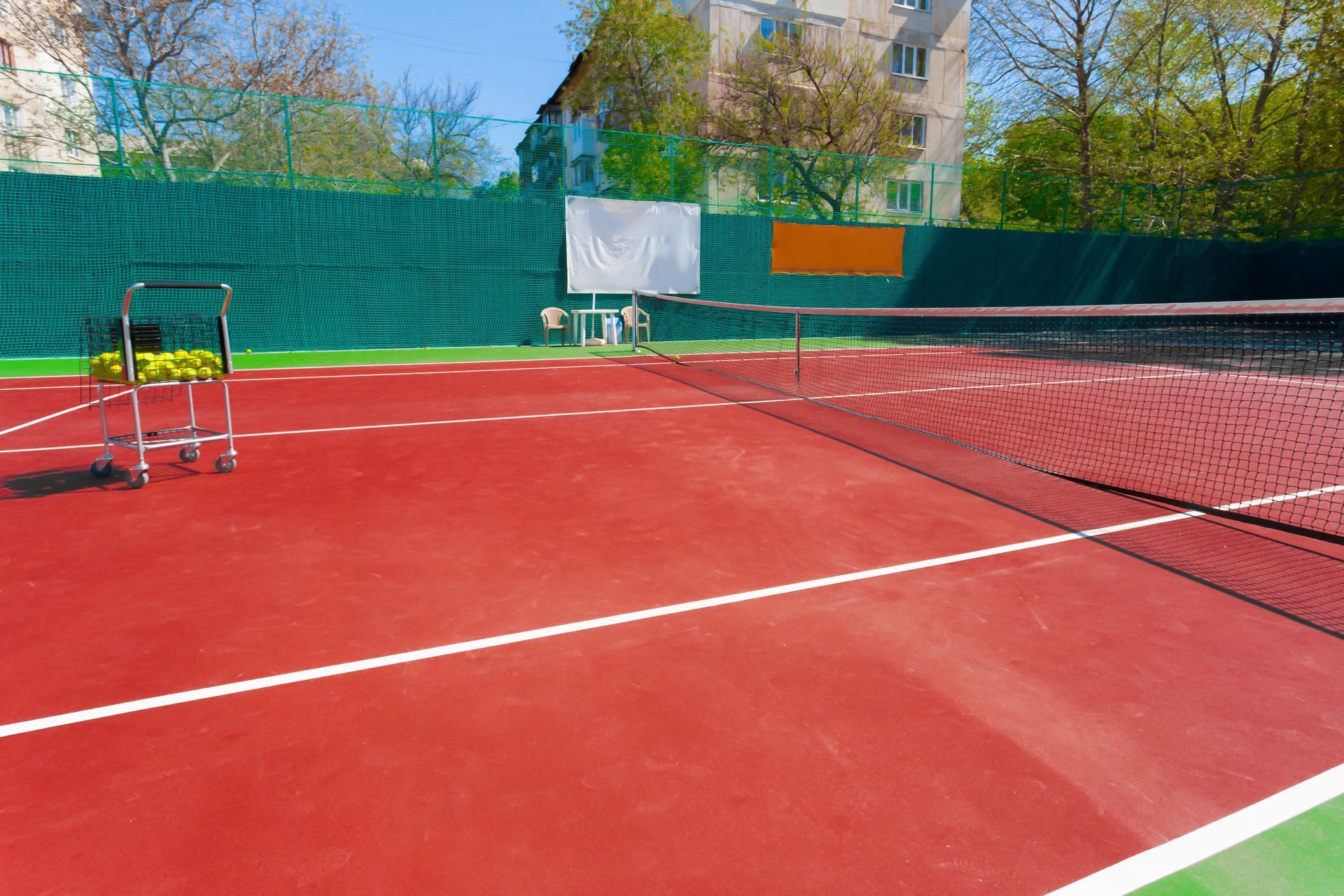
Empty red tennis court with net, ball cart, and green fence under a clear blue sky
May 29, 2026
Building public pickleball or tennis courts? ADA pickleball court compliance and ADA tennis court requirements are non-negotiable for parks departments. Mor-Sports Group is a licensed contractor and ASBA member serving Florida, Alabama, and beyond, with deep experience designing ADA-compliant public sports facilities.

Two people discuss a document while another person points with a pen during a meeting
May 15, 2026
Worried about HOA tennis court liability in Florida? This guide covers HOA pickleball insurance in Florida, waivers, posted rules, surface-related injury claims, and how proper court construction reduces risk. Mor-Sports Group is a licensed Florida contractor with 35+ years of experience building safer courts. Contact

Hand holding a pencil over documents beside a laptop on a desk
May 1, 2026
Writing athletic court bid spec for your HOA or condo board? Learn exactly what to include in an HOA sports facility RFP so you get apples-to-apples quotes and avoid change orders. Mor-Sports Group is a licensed Florida contractor and Official Court Builder of the US Open Pickleball Championship.
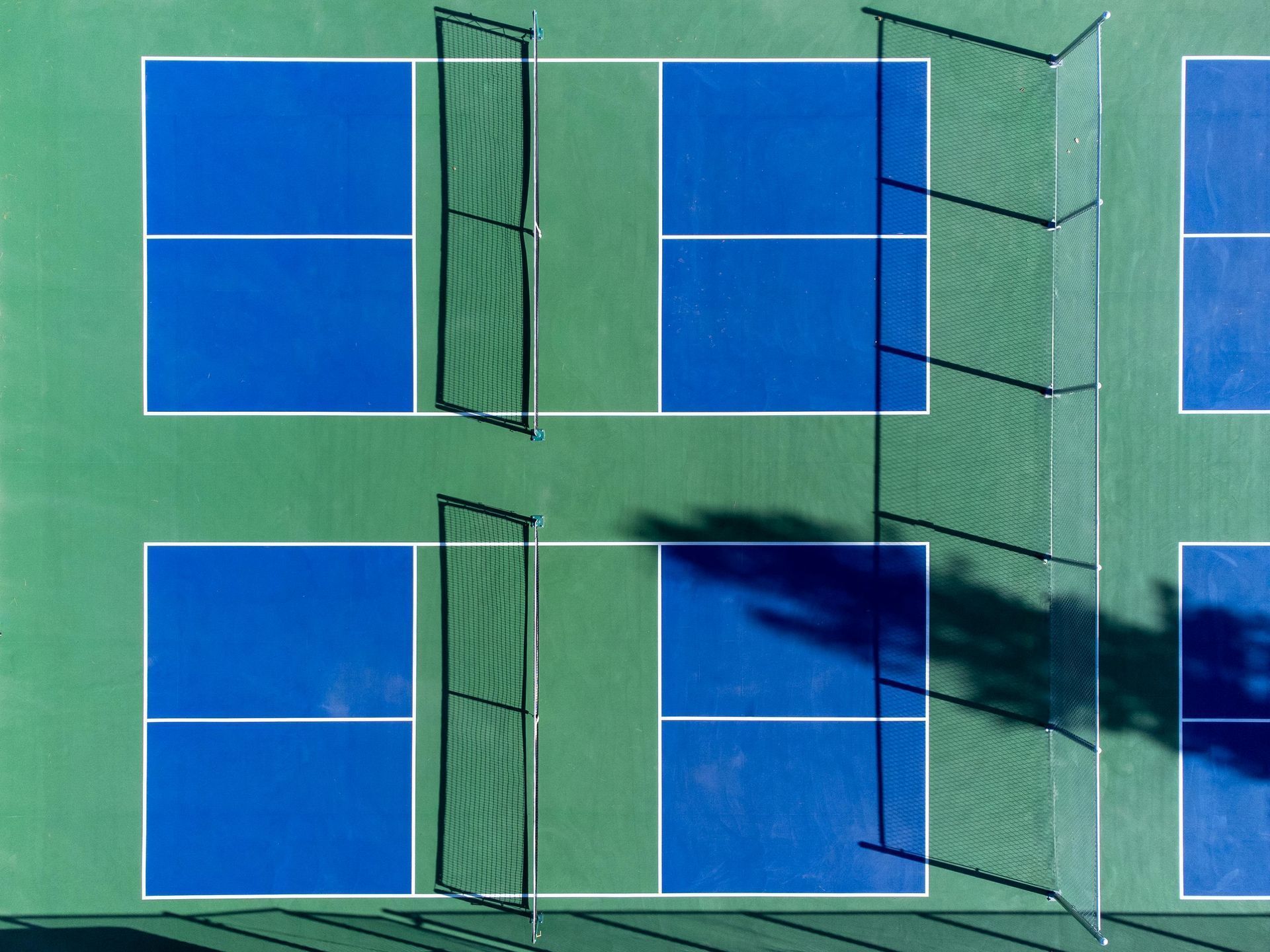
Aerial view of a green tennis court with blue service boxes and court shadows.
April 14, 2026
Navigating pickleball court setbacks in Florida? This guide covers Florida condo association pickleball rules, municipal zoning setbacks, buffer requirements, and how Mor-Sports Group designs code-compliant courts for HOAs and condo associations across Florida. Licensed Florida contractor with 35+ years of experience. Contact us today.
Pickleball paddle and ball on a blue court near the net
April 14, 2026
Planning a pickleball court for your Florida HOA? Learn how pickleball court noise Florida HOA rules work, what local noise ordinances allow, and how Mor-Sports Group designs sound-mitigated courts that keep your community and neighbors happy. Licensed Florida contractor, Official Court Builder of the US Open Pickleball Championship. Request a quote today.
Wide view of empty soccer field under a bright blue sky with scattered clouds
March 8, 2026
Maximize synthetic grass field safety with Mor-Sports' best practices. Learn essential guidelines for player injury prevention, field maintenance, and athletic regulations.
Paddle and yellow ball on a blue pickleball court near the net
February 27, 2026
Complete guide to maintaining pickleball courts. Learn essential care routines, seasonal maintenance, common problems, and professional tips to keep your courts in championship condition year-round.
Show More