USA Pickleball Court Lighting Standards vs. Local Dark-Sky Ordinances: Navigating Both
Parks departments adding lights to pickleball courts face a technical challenge that didn't exist ten years ago: USA Pickleball's recommended lighting levels are written for visibility, while a growing number of Florida municipalities have adopted dark-sky or light-trespass ordinances written for environmental protection and neighbor relations. Both sets of requirements are legitimate. Meeting both requires deliberate fixture selection and design rather than simply ordering the same poles and fixtures used on the last project.
USA Pickleball Lighting Recommendations for Rec and Tournament Play
USA Pickleball's current facility standards distinguish between recreational and tournament play lighting levels. For recreational play, the recommendation is a minimum of 30 foot-candles (fc) average at the court surface, measured horizontally at 36 inches above the court. For tournament play, the standard rises to 50 fc minimum average, with a uniformity ratio (maximum to minimum) of no greater than 2.5:1.
Foot-candle levels that sound sufficient on paper can perform poorly in practice if uniformity is poor. A court with 30 fc average that has 10 fc pockets in the back corners will feel poorly lit for evening play even though it technically meets the average threshold. Lighting design for courts should specify both average levels and uniformity ratios.
For courts intended to host sanctioned USA Pickleball tournament play, the lighting system should be designed and documented to meet the tournament standard, and that documentation should be available for event certification reviews.
What Dark-Sky Ordinances Actually Regulate
Dark-sky ordinances regulate light pollution: the emission of light beyond the property it's intended to illuminate, including upward scatter (sky glow), horizontal spill (light trespass onto neighboring properties), and glare. They are distinct from general noise or nuisance ordinances, though courts subject to complaint often face both.
In Florida, coastal municipalities have been among the most active in adopting dark-sky protections, driven largely by sea turtle conservation requirements. Coastal construction in Florida already requires low-profile, amber-wavelength lighting in certain zones to avoid disorienting nesting sea turtles. While this requirement applies primarily to oceanfront properties, it has influenced the lighting regulatory culture in communities like Naples, Marco Island, and Sanibel.
Non-coastal municipalities have adopted dark-sky ordinances for different reasons, primarily to reduce energy consumption, preserve neighborhood character, and address resident complaints about light spill from commercial and recreational facilities. Fort Myers, Gainesville, and a number of Central Florida municipalities have general outdoor lighting codes that affect sports facility design.
Full-Cutoff Fixtures, Shielding, and Glare Control
The core technical requirement in most dark-sky ordinances is the use of full-cutoff or shielded fixtures. A full-cutoff fixture emits no light above the horizontal plane of the fixture. This means zero upward light emission, which eliminates sky glow from the fixture itself. Shielded fixtures use internal or external baffles to control horizontal spill and glare in specific directions.
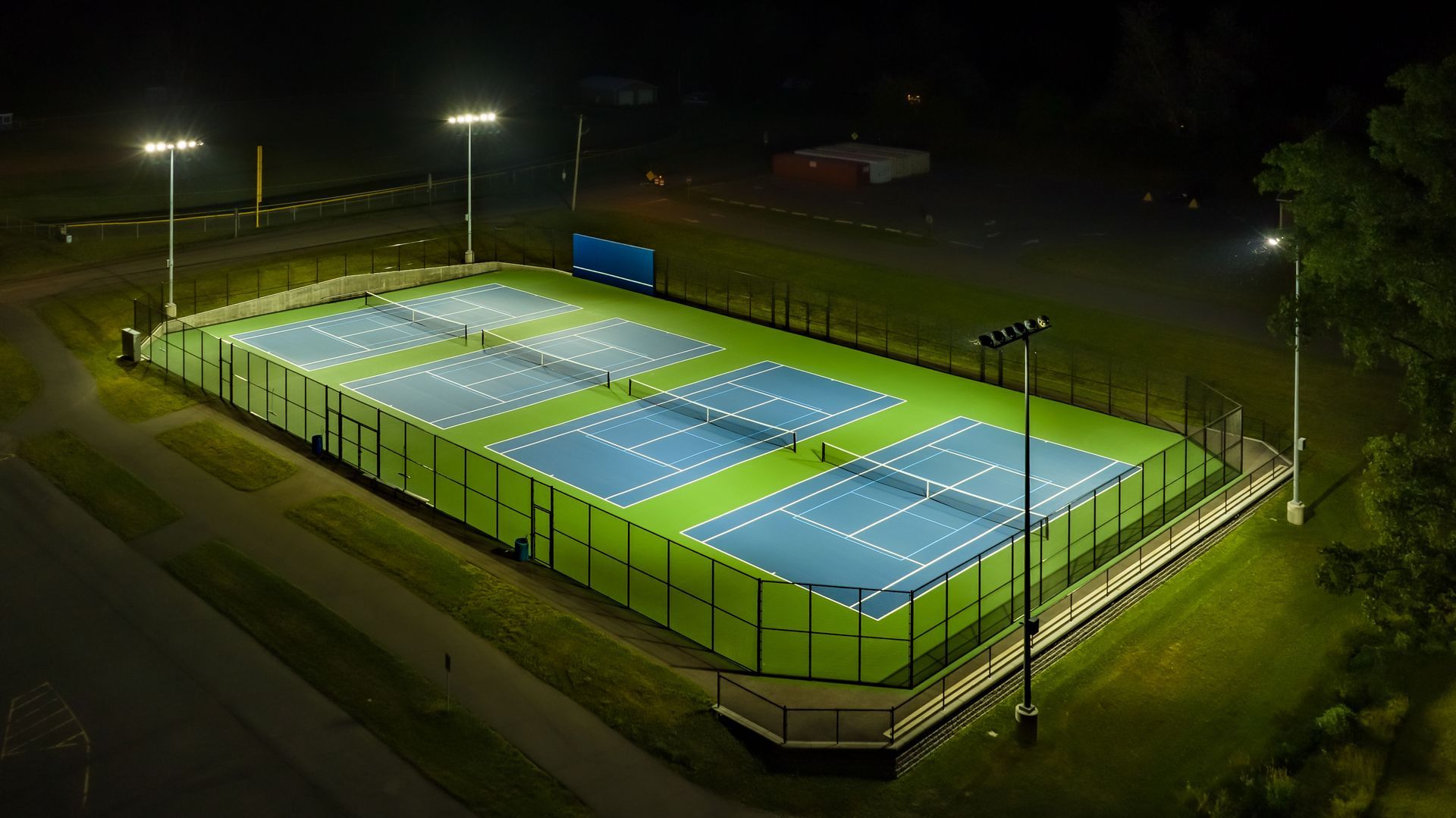
For sports court lighting, full-cutoff LED fixtures mounted on poles at appropriate height can meet both USA Pickleball foot-candle requirements and dark-sky ordinance restrictions, but the design has to be done intentionally. Simply mounting compliant fixtures at the wrong height or spacing won't achieve the required foot-candles without generating spill.
The physics work in favor of properly designed systems: LED fixtures with full-cutoff optics can be designed with asymmetric beam patterns that concentrate light on the court surface while cutting off abruptly at the perimeter. This is the right solution for courts adjacent to residential properties or within dark-sky regulated zones.
Mounting Height, Pole Spacing, and Light Uniformity
Standard mounting heights for pickleball and tennis court lighting range from 18 to 30 feet depending on court size, number of courts, and uniformity requirements. Lower mounting heights reduce sky glow but require more poles and closer spacing to maintain uniformity. Higher mounting heights provide better coverage from fewer poles but may produce light spill beyond the court perimeter if fixtures aren't precisely aimed.
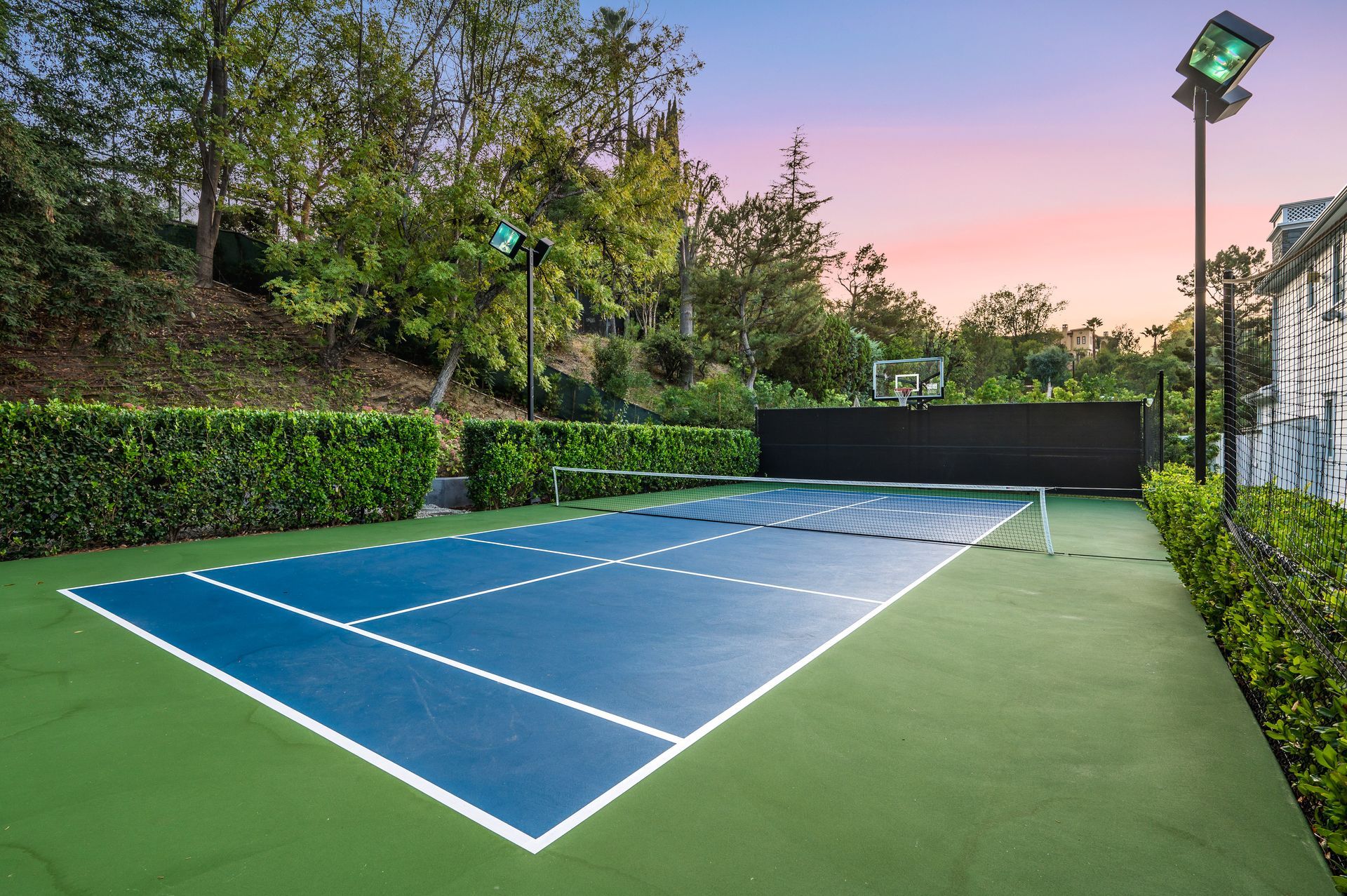
For a pair of adjacent pickleball courts (a common configuration in municipal parks), four poles at roughly 20 to 25 feet height at the four corners of the combined court footprint, with properly specified fixtures, is a common starting point. Actual design should be based on a photometric analysis, which shows foot-candle distribution across the court surface and identifies any pockets that fall below the minimum threshold or any spill that exceeds the ordinance limit.
Don't accept a lighting bid that doesn't include a photometric study. A contractor who can't produce one can't guarantee the system will perform as specified.
Color Temperature (K) and CRI Recommendations
LED fixtures are specified by color temperature in Kelvin and color rendering index. For sports courts, color temperature and CRI affect ball visibility and player ability to track fast-moving objects.
USA Pickleball recommends a color temperature of 4,000 to 5,700 K for court lighting. This range produces a neutral to cool white light that renders colors accurately and maintains contrast between the ball and court surface. Warmer temperatures (below 3,000 K) reduce ball visibility for fast play. Cooler temperatures above 5,700 K produce harsh blue-white light that many players find fatiguing.
CRI should be 70 or above for recreational courts and 80 or above for tournament play. Higher CRI means colors appear more natural under the light, which matters both for player experience and for broadcast-quality courts.
Dark-sky ordinances in coastal Florida sometimes restrict color temperature to 3,000 K or below in sea turtle zones. In those locations, achieving adequate court visibility under the color temperature restriction requires a careful photometric design and, in some cases, a variance process.
LED Retrofits for Existing Courts
Parks departments with existing metal halide or high-pressure sodium court lighting have a straightforward path to dark-sky compliance through LED retrofit. Modern LED systems deliver comparable or better foot-candle levels at 40 to 60% lower energy consumption, with vastly better controllability, longer lamp life, and full-cutoff optic options that weren't available in older fixture types.
A retrofit project should include a photometric analysis of the proposed LED system to confirm it meets current USA Pickleball standards before procurement. It should also confirm that the new fixtures qualify as full-cutoff under the applicable dark-sky ordinance, since some older fixture housings retrofitted with LED kits don't qualify because the housing itself doesn't meet full-cutoff geometry.
Energy savings from LED conversion frequently qualify for utility rebates in Florida. Florida Power and Light and Duke Energy both operate commercial lighting incentive programs that can offset a portion of the retrofit cost. Check current program availability when budgeting the project.
How to Spec Lighting in a Compliant RFP
A lighting specification in a parks department RFP should require bidders to provide a photometric study demonstrating compliance with both the minimum foot-candle standard and the applicable ordinance's maximum spill or cutoff requirements, specify LED full-cutoff fixtures with a minimum color temperature range and CRI, state mounting height minimums and maximums, and require documentation that proposed fixtures comply with the specific dark-sky or outdoor lighting code applicable to the site.
Require fixture submittals and photometric calculations before award, not after construction begins. Discovering that proposed fixtures don't meet the ordinance after poles are in the ground is expensive.
Mor-Sports Group is the Official Court Builder of the US Open Pickleball Championship and has designed and built lighting systems for pickleball and tennis courts from community parks to tournament facilities across Florida. Contact us to discuss your next court lighting project.